Roger Klemm walks through the ins and outs of starting and funding a garden project in common space.
Sunland Welcome Nature Garden Update from Roger Klemm from SunlandTujungaNC on Vimeo.
Roger Klemm walks through the ins and outs of starting and funding a garden project in common space.
Sunland Welcome Nature Garden Update from Roger Klemm from SunlandTujungaNC on Vimeo.
Here are a few of our favorite moments in the garden, as captured by our Facebook friends.


By Cassy Aoyagi: Both Stipa tenuissima and Aristide purpurea grasses provide vertical visual interest and tendrils that will wave in a breeze. In addition, both actually perform without much water.
Curious as to how Stipa earned its seat on the [wet-to-dry] exchange? A clue: Stipa’s seeds place it in the same category as Pennisetum and Pampass grasses – invasives that are nothing but trouble!
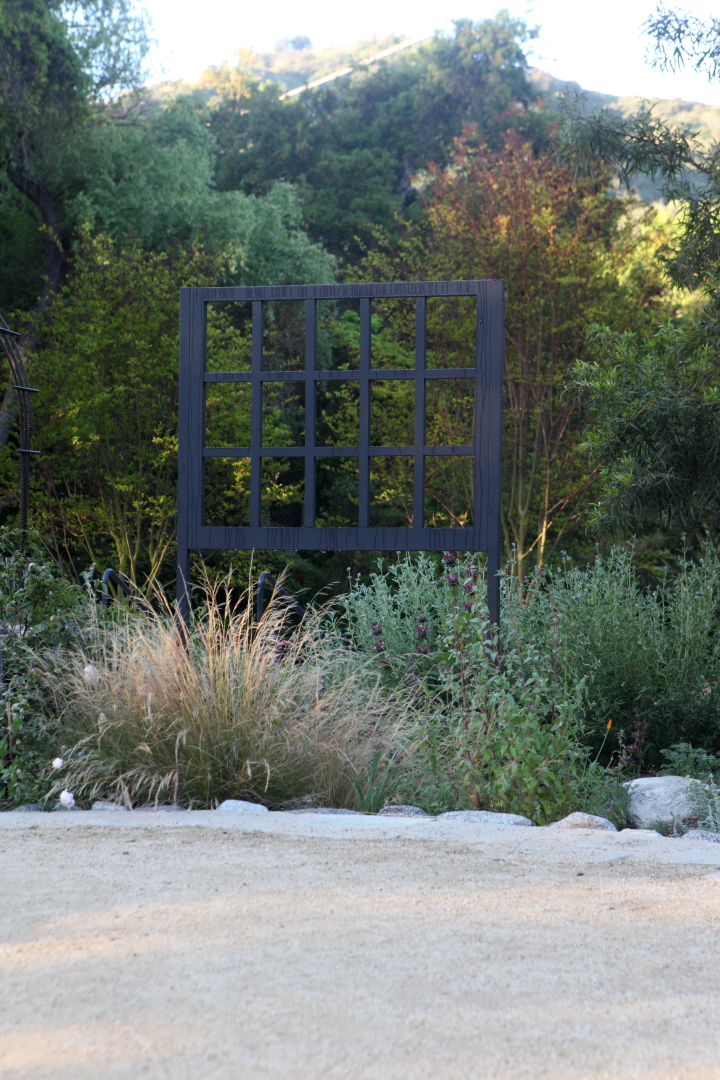 Aristada Purpurea
Blondes do not always have more fun! This sweet grass, native to areas throughout California, has a lot of Stipa-like characteristics. Unlike Stipia, Aristida purpurea does not increase fire danger, supports wildlife and will maintain its place. As an exchange, Aristida has some distinctive charms:
Provides the same height and texture. Aristida is a very light and airy textured grass that reaches the same height as Stipa, with a narrow and upright form.
Pops with PURPLE seed heads. What could be prettier! When in seed, Aristida purpurea takes on some of the “blonde” colored qualities as the Stipa, but the contrast of the purple seed heads is glorious. It won’t get as thick as a Stipa, but you can counter that by planting more clumps of it to make your point.
Attracts birds. Aristida sings!
Holds its looks in the long term. Very low water, Aristida purpurea grass will look its best during the warm seasons, but being a perennial, will hold its own year round.
Is hassle-free. It may enjoy your admiration, but it won’t require much attention – just a little cut back toward the end of summer.
Pair Aristada with companions and materials that will not overwhelm it and with colors that will contrast nicely against it, like, Festuca idahoensis,Carex tumilicola, Carex glauca or Artemisia ‘Canyon Grey’ or ‘Davids Choice‘.
Stipa Tenuissima, Mexican Feather Grass
Stipa tenuissima, local to areas all over the US has a blonde color and fine texture matched by no other grass, making it eye-catching and highly desirable from an aesthetic perspective. One aspect of that fine texture is the multiplicity of seeds that the grass produces. If not for the terribly invasive nature of its seeds, this grass would have a big thumbs up. Unfortunately, Stipa, like other invasives:
Create fire danger. While they outperform natives during the good times, invasives tend to dry up when the going gets tough. The more invasives we have in our hills, the more we exacerbate the fire, flood, slide cycle.
Can’t stay put. By definition, an invasive is a wanderer that will quickly leave its spot in the garden to explore the rest of your landscape… and California hillsides.
Repel wildlife. Invasives often outperform the native foliage, leaving native species of wildlife bereft of sustenance and shelter.

By Cassy Aoyagi: Two plants provide plumes of white that look like large sticks of cotton candy peppering California hillsides. Don’t be fooled! Both have spikey foliage capable of taking a good bite out of you! One is native here and throughout much of the warm-weathered U.S., and it is well adapted to fight drought and fire. The other invaded our hillsides and bears responsibility for a good share of Los Angeles’ fire, flood, slide cycle. Which will you choose to have in your garden?
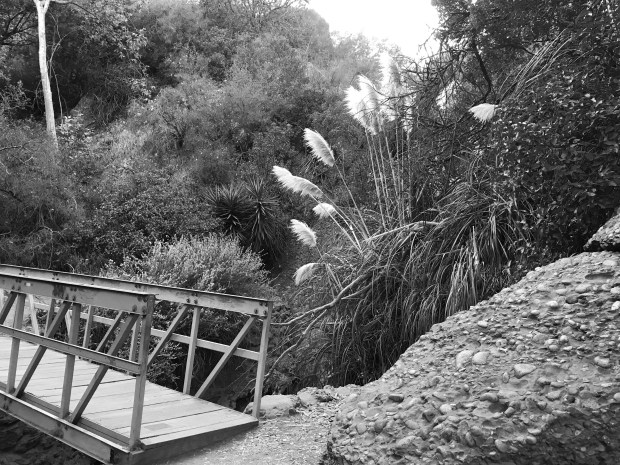
Foam-capped waves of the ocean line one side of the Pacific Coast Highway, cliffs of feathery white the other. We see so much Pampas Grass in our wild spaces, it is easy to believe it belongs there. It does not!
Pampas Grass was introduced as an ornamental for erosion control. It was not an entirely illogical choice. It thrives in hot sun, adapts to a wide variety of soils, and resists deer. Now well established in our community, Pampas Grass makes profound contributions to our fire, flood, slide cycles. Why?
Ironically, there is a lovely California native with truly unique blooms and extraordinary architectural foliage that retains slopes with none of the Pampas’ downside.
Coming upon a Yucca Whipplei sparks wonder. Prevalent from the coast to the alpine regions around California, Yucca’s blue-grey, spikey and highly architectural foliage can be as much as 6’ feet in diameter where it has space to grow. A pretty extraordinary wet-to-dry exchange, Yucca actually likes periods of completely dry soil.
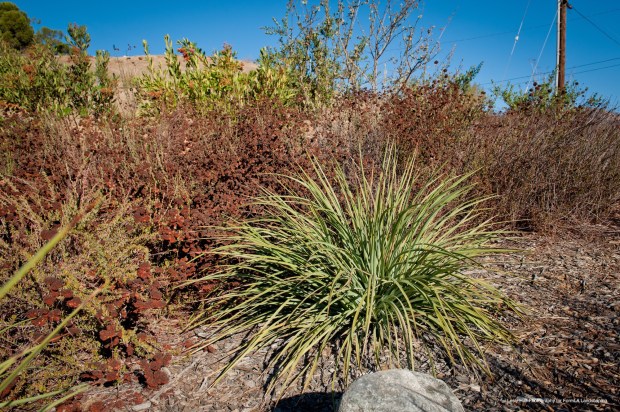
Yucca, another edible fire fighter, finds spots nestled within the California Buckwheat.
Yucca’s blooms are both impressive and unique. Lasting for weeks, hundreds of bell-like flowers form clusters that top 8’ foot spikes. They fill the hills in June, wrapping up their bloom in early July. Check out rocky slopes to catch the last of these magnificent “candles” interspersed with fully blooming Eriogonum fasciculatum (California Buckwheat), and Zauchneria species.
Yucca has its own downsides – harmless quirks, really. After Yucca’s bloom, the full plant dies. Its pups and seeds then create new plants in its place. These pups and plants will take several years to bloom themselves. Also, like Pampas Grass, sharp Yucca leaves can bite and slice, so it’s smart to place them away from paths and walks.

 Sunland Welcome Nature Garden